
AI for L&D professionals: build learning that moves the business.
AI should not replace instructional design instincts. Used well, it becomes a thinking partner that helps L&D move from order-taker to strategic problem solver.


On this page
What business alignment actually means
Business-aligned instructional design is not about making a course sound corporate. It is about solving a problem a stakeholder would fund.
A request for communication skills is vague. A decline in customer satisfaction because managers struggle to de-escalate charged conversations is a business problem. L&D becomes strategic when it starts with that second frame.
Use AI to diagnose the real problem
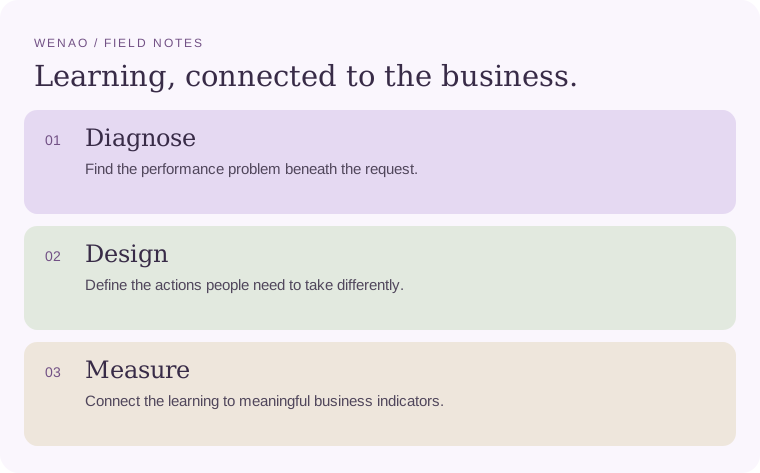
Most training requests arrive as solutions. AI can help reverse-engineer the underlying performance problem before a module, deck or workshop is designed.
Ask AI to generate diagnostic questions, identify possible business outcomes and prepare stakeholder prompts. This helps L&D walk into conversations with sharper thinking instead of simply accepting the requested course.
Use AI to learn the business faster
One of the biggest barriers for L&D is not knowing the business deeply enough. AI can accelerate research into roles, KPIs, regulatory context, customer reality and performance breakdowns.
It can summarize documents, simulate SME conversations and help you prepare better questions. The goal is not to replace expertise. The goal is to arrive prepared for it.
Map learning to outcomes
Stakeholders talk about productivity, risk, revenue, patient experience, customer satisfaction, retention and time to competency. L&D often talks about modules, objectives and completion rates.
AI can help translate between these languages. It can map critical actions, pressure-test a learning strategy and build measurement plans before launch.
Design for performance, not knowledge
A business-aligned learning experience does not stop at awareness. It asks what people must do differently after the learning ends.
AI can help convert business outcomes into performance actions, practice scenarios, feedback loops and manager reinforcement tools.
Speak the language of ROI
The business does not need every learning program to have a perfect financial model, but it does need clarity on value.
Use AI to connect the learning design to measurable indicators: faster onboarding, fewer errors, better customer conversations, stronger compliance or improved leadership behaviors.
AI as a thinking partner
AI should not replace instructional design instincts. Used well, it becomes a thinking partner that makes your assumptions visible.
It can challenge weak logic, strengthen stakeholder questions, generate alternatives and help L&D move from order-taker to strategic problem solver.
Arzoo Choudhary
Founder of WENAO. Writing on work, learning and the human side of growth.
Meet the person behind the practiceA different perspective.



More thinking. A considered next step.